In sealing systems, performance is rarely defined by the profile shape alone. Long-term reliability depends on how that profile behaves under real operating conditions, temperature swings, repeated movement, and continuous compression cycles.
That’s where thread insert extrusion becomes a practical engineering advantage.
Thread insert is an advanced extrusion process that integrates a fiberglass strand directly into a solid EPDM or VMQ (silicone) profile during manufacturing. The purpose is clear: improve durability, strengthen dimensional stability, and increase resistance to contraction and expansion over time.
What is thread insert extrusion?
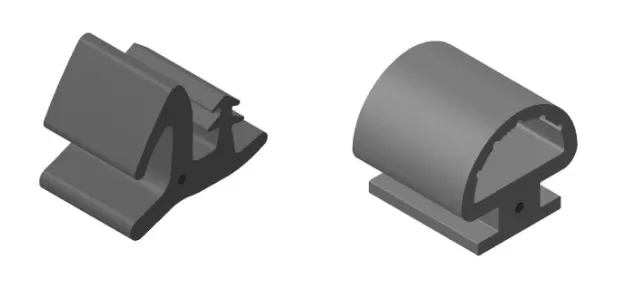
Thread insert extrusion is a reinforcement method used during profile manufacturing. A fiberglass strand is embedded inside the rubber profile as it is extruded, creating a composite structure: elastomer performance on the outside, reinforced stability inside.
This helps the profile maintain consistent geometry throughout its service life, especially in applications where small dimensional changes can impact fit-up, compression behavior, and system integrity.
Why dimensional stability matters in sealing performance
Many failures and service issues begin with small, gradual changes:
- geometry drift over time
- compression behavior that becomes inconsistent
- fit-up that changes across thermal cycles
- higher installation adjustments or rework
A reinforced profile supports stability so the seal behaves more predictably, even when operating conditions are demanding.
Key performance benefits of fiberglass thread insert
When integrated correctly, thread insert profiles support:
1) Higher dimensional stability
Reinforcement helps the profile maintain its intended shape and fit-up over time.
2) Better resistance to contraction and expansion
Fiberglass thread supports stability under thermal cycling and changing environmental conditions.
3) Improved long-term durability
Reinforcement can reduce deformation risk and support consistent performance across extended service cycles.
Typical applications
Thread insert extrusion is commonly used in industries where sealing profiles must perform reliably under operational stress:
Automotive
Used in seals for doors, windows, and exhaust-related systems, where repetitive motion and temperature changes are common.
Construction
Applied in insulation profiles and expansion joints, where stability supports long-term building performance and consistent installation fit-up.
Aerospace
Used in sealing components exposed to extreme temperature and pressure conditions, where durability and shape retention are critical.
EPDM vs VMQ (Silicone): selecting the right material base
Thread insert reinforcement can be integrated into multiple elastomer systems depending on the application:
- EPDM + fiberglass thread: strong for outdoor durability and stability-focused applications
- VMQ (silicone) + fiberglass thread: suited for environments requiring silicone performance characteristics paired with structural reinforcement
Material selection should align with operating conditions, expected movement, and long-term system requirements.
Engineering-first support from TrustSeal
At TrustSeal, this capability fits into our broader approach: engineering-first partnerships. We support customers by aligning:
- profile design intent
- material behavior
- reinforcement strategy
- manufacturing feasibility
So performance goals are supported by a repeatable, manufacturable solution, not just a drawing.
Let’s review your application
If you’re evaluating reinforcement options for a current sealing profile, or want to improve long-term dimensional stability, our team can support a technical review.
➡️ Connect with us: https://trustsealcorp.com/contact-us/