In high-performance sealing systems, the material is only part of the solution. The real value comes from how the material, geometry, hardness, and application requirements work together.
That is where rigid / foam coextruded profiles become especially relevant.
These profiles combine a rigid or semi-rigid core with a cellular foam sealing section, commonly made from EPDM or VMQ silicone. The result is a technical sealing profile that can provide structure, anchoring, compression, and recovery in a single engineered component.
At TrustSeal, this capability is part of the company’s Double Coextrusion Hardness in EPDM or VMQ process, described as an advanced method for composite products made from two materials, allowing each material to contribute its own technical and mechanical advantages depending on the application.
What Are Rigid / Foam Coextruded Profiles?
Rigid / foam coextruded profiles are sealing components manufactured through a coextrusion process that brings together two different material behaviors in one continuous profile.
One section of the profile is typically solid, rigid, or semi-rigid, providing support, anchoring, guidance, or dimensional stability.
The second section is made from cellular foam EPDM or foam VMQ silicone, designed to compress against the surface and recover after deformation.
This combination allows the profile to perform two different functions at the same time:
The rigid section supports the system.
The foam section seals the interface.
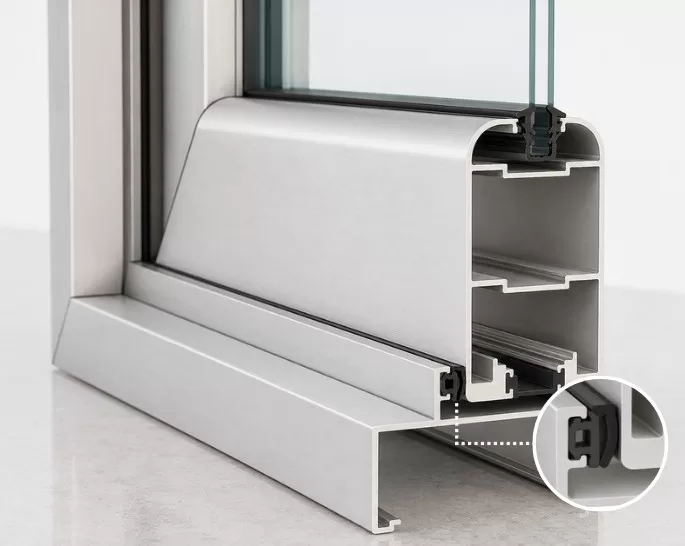
TrustSeal describes this approach in architectural systems as a way to improve installation by using a harder material for anchoring and a softer material for compression, helping ensure sealing and insulation performance.
Why Combine Rigid and Foam Materials?
A single-material profile can perform well in many applications, but some systems require a more advanced balance between structure and flexibility.
Rigid / foam coextruded profiles help solve this challenge by combining:
Structural support
The rigid or semi-rigid section helps the profile stay in position during installation and service.
Compressible sealing
The foam section adapts to the contact surface and helps close gaps between components.
Recovery after compression
Foam EPDM or foam VMQ can support repeated compression and recovery, depending on the compound and application.
Improved fit
The profile can be engineered to match the assembly conditions, tolerances, and contact points of the system.
Functional integration
Instead of using multiple components, one coextruded profile can combine anchoring and sealing behavior.
This is especially important in systems where the seal must remain stable while also absorbing movement, compression, and environmental exposure.
EPDM Foam vs. VMQ Silicone Foam
The choice between EPDM and VMQ depends on the environment, performance requirement, and application.
EPDM Foam
EPDM is widely used in exterior sealing applications because of its resistance to weathering, ozone, water, steam, and UV exposure. TrustSeal’s industry materials page also highlights EPDM, silicone, and TPE as recommended materials for outdoor applications.
Foam EPDM is commonly used when the application requires:
- Weather resistance
- Water and air sealing
- Compression behavior
- Outdoor durability
- Cost-effective long-term performance
It is especially useful in architectural and industrial sealing systems where the profile is exposed to changing environmental conditions.
VMQ Silicone Foam
VMQ silicone foam is often selected for applications that require broader temperature performance, flexibility, and stable behavior under demanding conditions.
It is useful when the system requires:
- Higher temperature resistance
- Soft compression
- Good recovery behavior
- Long-term flexibility
- Specialized environmental performance
VMQ silicone can be especially valuable in applications where thermal variation, aging, and compression behavior are critical to long-term sealing performance.
Main Benefits of Rigid / Foam Coextruded Profiles
1. Better Compression Control
The foam section allows the seal to compress against the surface while the rigid section helps maintain proper positioning.
This helps the profile create a more controlled contact point in the assembly.
2. Stronger Installation Stability
The harder section can function as an anchoring or guiding element, reducing movement during installation and supporting a more reliable fit.
3. Improved Sealing Consistency
By combining support and compression in a single profile, the seal can maintain more consistent contact with the system interface.
4. Reduced Need for Multiple Components
A coextruded profile can simplify assembly by integrating two functions into one part.
This can support faster installation, fewer handling steps, and a cleaner system design.
5. Application-Specific Performance
Each section of the profile can be engineered around the system’s real requirements: compression force, gap variation, geometry, exposure, and long-term performance expectations.
Common Applications
Rigid / foam coextruded profiles are especially valuable in industries where sealing depends on both mechanical fit and compressible contact.
Glazing and Curtain Wall Systems
In curtain wall and window systems, these profiles can support perimeter sealing, air and water control, thermal performance, acoustic behavior, and movement accommodation.
They are useful in:
- Curtain wall systems
- Architectural windows
- Storefront systems
- Door and frame assemblies
- Glass and aluminum interfaces
TrustSeal’s glazing catalog includes products for curtain walls, light façades, architectural windows, and high-precision enclosures, which are applications where sealing performance directly affects long-term system behavior.
Port Infrastructure and Hatch Joints
In port infrastructure, hatch joints and access systems may require seals that can compress reliably while staying stable in demanding environments.
Rigid / foam coextruded profiles can help support:
- Hatch sealing
- Access panel joints
- Compression under closure pressure
- Environmental exposure resistance
- Long-term recovery after repeated use
Industrial Panels and Doors
Industrial panels and doors often require seals that can handle vibration, movement, repeated opening and closing, and environmental variation.
Applications may include:
- Industrial doors
- Equipment panels
- Enclosures
- Access covers
- Perimeter gaskets
- Custom sealing systems
In these cases, the rigid section can help with installation and retention, while the foam section provides sealing contact.
What Defines a Good Coextruded Profile?
A high-performance coextruded profile depends on more than choosing two materials. It requires engineering alignment between the profile and the application.
Key factors include:
Material compatibility
Both materials must work together during extrusion and in the final application.
Hardness balance
The rigid section must provide enough support, while the foam section must provide the right compression.
Geometry
The shape of the profile defines how it installs, compresses, seals, and recovers.
Compression behavior
The foam section must respond correctly to the expected pressure and gap conditions.
Environmental exposure
UV, temperature, moisture, chemicals, and movement all influence material selection.
System tolerance
The profile must be designed around real assembly variation, not only ideal conditions.
Why Coextrusion Matters in Sealing Design
A sealing profile is not just a piece of rubber. It is a functional component that controls contact, pressure, movement, and protection.
Coextrusion allows engineers to design a profile with different performance zones:
- A harder zone for anchoring or structure
- A softer zone for compression and sealing
- A geometry adapted to the specific assembly
- A material combination selected for the environment
This is why coextruded profiles are especially relevant for systems that require both fit stability and long-term sealing consistency.
TrustSeal Capabilities: Double Coextrusion Hardness in EPDM or VMQ
TrustSeal’s Double Coextrusion Hardness in EPDM or VMQ capability is focused on creating composite products that combine different materials or hardness levels to achieve technical and mechanical advantages according to the application.
The website lists material combinations such as:
- Sponge EPDM + Solid EPDM
- Solid EPDM + Solid EPDM with different hardnesses
- Spongy VMQ + Solid VMQ
- Solid VMQ + Solid VMQ with different hardnesses
This capability is particularly valuable for customers who need a sealing solution that is engineered around real application conditions rather than a generic profile.
Rigid / foam coextruded profiles bring together two essential sealing behaviors: structure and compression.
The rigid or semi-rigid section supports positioning, anchoring, and stability. The foam EPDM or VMQ section provides compressible contact, recovery, and sealing consistency.
For glazing systems, port infrastructure, industrial panels, and custom door applications, this combination can help improve installation, sealing performance, and long-term reliability.
At TrustSeal, we develop coextruded sealing solutions designed around your application, material requirements, and performance goals.
Let’s develop the right sealing profile for your system.