Glazing systems are built from many visible and invisible components: glass, aluminum framing, accessories, setting blocks, spacers, sealants, and gaskets. Each element contributes to the way the system performs over time.
A gasket may look like a small component, but its function is highly technical. It helps support air control, water resistance, thermal comfort, acoustic performance, movement absorption, glass positioning, assembly consistency, and long-term durability.
As the glass, window, and door industry gathers at GlassBuild America 2026 in Las Vegas, presented by the National Glass Association (NGA), it is a good moment to talk about one of the most important conversations behind glazing performance: how the right gasket is developed from an application requirement into a reliable, repeatable sealing solution.
At TrustSeal, our approach is engineering-first. We support manufacturers, glazing teams, and project stakeholders from the first technical conversation through design, tooling, validation, and production. The goal is to develop sealing solutions around the real conditions of each system, not around a generic profile.
Understanding the Application Comes First
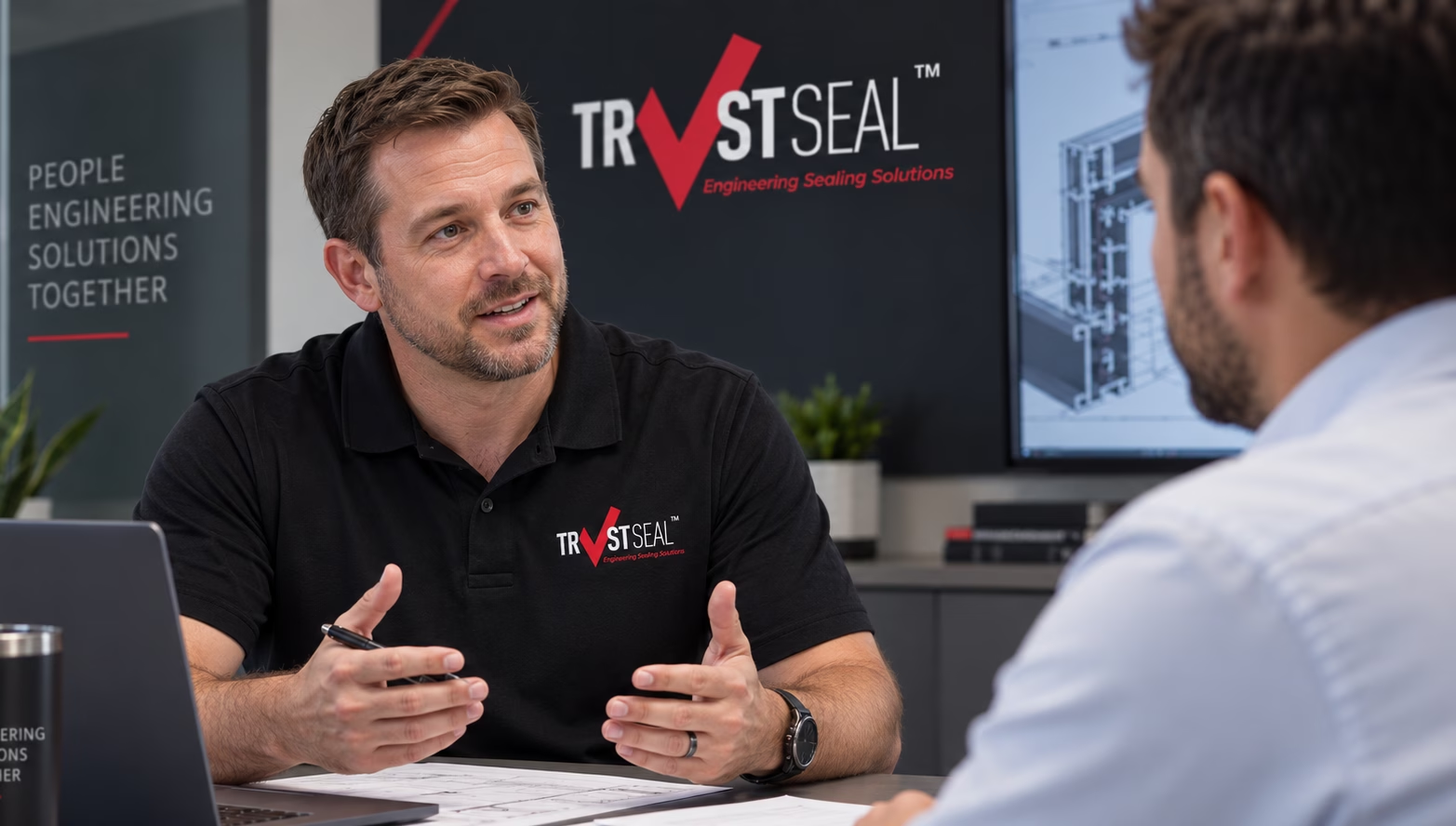
A custom gasket starts with a technical conversation.
Before selecting a material or drawing a profile, the application must be understood clearly. A gasket for a curtain wall system does not work under the same conditions as a storefront, a pressure-glazed window, a commercial entrance, or a retrofit application.
The engineering review should consider:
- What type of glazing system will use the gasket?
- Is the application interior, exterior, structural, or non-structural?
- What materials are in contact with the gasket?
- What are the glass thickness, aluminum cavity, and assembly tolerances?
- Will the system face water exposure, wind pressure, UV, ozone, temperature changes, or frequent movement?
- Does the profile need to support thermal comfort, acoustic control, sliding movement, or installation efficiency?
- Are there compatibility requirements with sealants, silicone, coatings, or adjacent materials?
This step is essential because gasket performance depends on the full system. In glazing, the seal interacts with glass, aluminum, movement, pressure, installation conditions, and environmental exposure. TrustSeal’s internal content strategy defines this as a core educational territory: air and water control, sealing continuity, compression behavior, material selection, gasket geometry, glass-aluminum interfaces, thermal cycling, UV and ozone exposure, installation tolerances, and field variability.
Defining the Functional Requirements
Once the application is understood, the next step is defining what the gasket must do.
In glazing systems, a gasket can contribute to several functions at the same time:
Airtightness
A gasket helps control unwanted air movement through the system. This matters for comfort, energy performance, and system consistency.
Watertightness
The gasket contributes to water control by supporting the seal between glass, frame, and adjacent components. In curtain wall, storefront, window, and door systems, water management is directly connected to geometry, compression, drainage paths, and installation quality.
Thermal Performance
A well-designed seal helps reduce uncontrolled air exchange and supports the overall thermal behavior of the system. The gasket is part of the envelope strategy, especially when comfort and energy performance are important.
Acoustic Performance
When the gasket maintains consistent contact and supports sealing continuity, it can help reduce paths for exterior noise transmission. This is especially relevant in residential glazing, commercial buildings, hotels, offices, and high-traffic urban areas.
Movement Absorption
Glazing systems move. They expand, contract, vibrate, deflect, and respond to wind, temperature, and installation conditions. The gasket must be developed with enough flexibility, recovery, and compression behavior to support those movements.
Assembly and Installation Support
A gasket also affects how the system is assembled. The right geometry can support easier installation, better fit, lower friction in sliding applications, and more consistent positioning of components.
TrustSeal’s internal technical material describes gaskets as components that support design and material selection, controlled processes, constant pressure, acoustic and thermal contribution, weather resistance, assembly comfort, and protection.
Material Selection: The Engineering Decision Behind the Seal
Material selection is one of the most important decisions in gasket development.
The material must respond to the operating environment, system design, expected lifecycle, and performance requirements. In glazing applications, common material considerations include EPDM, silicone rubber, TPE, TPV, PVC, and co-extruded combinations.
EPDM
EPDM is frequently used in exterior glazing applications because it is known for its resistance to weathering, ozone, and UV exposure. It can be used in systems where the gasket must maintain sealing behavior in demanding outdoor conditions.
Silicone Rubber
Silicone is often considered when the application requires stability across wider temperature ranges or when compatibility with structural silicone glazing must be evaluated. ASTM C1115 describes dense elastomeric silicone rubber gaskets and accessories used in sealing and glazing applications in building construction, including components used in compression sealing systems and structural silicone sealant glazing systems.
Dense Elastomeric Compression Gaskets
ASTM C864 covers preformed dense elastomeric compression gaskets, setting blocks, and spacers for use in sealing and glazing applications. This reinforces the importance of treating gaskets as technical components within the glazing system, not as secondary accessories.
TPE / TPV / PVC
Thermoplastic materials may be considered when the application requires specific processing, flexibility, dimensional characteristics, or production considerations. The decision depends on performance needs, system geometry, environment, and customer requirements.
Co-Extruded and Tri-Extruded Profiles
Some glazing applications require multiple functions in one profile. Co-extrusion and tri-extrusion can combine different materials or material behaviors in one gasket, such as rigid support, compressible sealing zones, and low-friction surfaces for sliding applications. TrustSeal’s material on co-extruded and tri-extruded profiles explains that these technologies support durability, functionality, and customization according to customer requirements, including architectural systems where thermal insulation, acoustic support, installation behavior, structural support, smooth sliding, and compressible sealing may need to work together.
Technical data, material performance, and compliance claims should be validated by the engineering team before publication or specification.
Geometry Defines Sealing Behavior
The same material can perform differently depending on geometry.
That is why gasket design is not only about choosing EPDM, silicone, PVC, or TPV. The profile shape determines how the gasket compresses, where it applies pressure, how it fits into the aluminum cavity, how it supports the glass, and how it responds to system movement.
Key geometry factors include:
- Compression zone
- Contact points
- Wall thickness
- Hollow chambers
- Ribs or lips
- Anchoring features
- Sliding surfaces
- Drainage compatibility
- Corner behavior
- Splice or vulcanized joint requirements
- Fit within the aluminum cavity
- Installation direction and force
A profile that is too loose may lose contact. A profile that is too tight may create installation issues or excessive closing force. A profile with the wrong compression behavior may affect water control, air control, movement, or long-term recovery.
This is why TrustSeal develops profiles around application geometry, not only around a drawing. The gasket must be designed for the system it will serve.
Climate, Exposure, and Location Matter
A glazing system in Florida, Texas, California, New York, or Illinois may face different conditions.
Climate affects gasket selection because exterior glazing systems can be exposed to:
- UV radiation
- Ozone
- Humidity
- Rain
- Wind pressure
- Temperature cycles
- Coastal or urban environments
- Thermal expansion and contraction
- Seasonal movement
- Long-term aging
For exterior systems, weather resistance is especially important. TrustSeal’s internal technical material highlights that the gasket material should resist UV, ozone, wind, and water, while its fit helps block wind, sound, insects, and temperature changes.
This is why the engineering conversation should include where and how the system will be used. The same gasket concept may require adjustments depending on exposure, climate, building type, and expected performance.
Acoustic and Thermal Requirements Should Be Defined Early
Comfort is not only created by glass selection. It is also influenced by the continuity of the seal.
When a project requires acoustic support, the gasket must help reduce pathways for air and noise transmission. When a project requires thermal performance, the gasket must support consistent contact, reduce uncontrolled air movement, and contribute to the system’s enclosure behavior.
This does not mean the gasket works alone. Glass, frame, installation, sealants, drainage, and system design all matter. But the gasket is one of the components that helps the system perform as a complete assembly.
TrustSeal’s technical material identifies acoustic and thermal contribution as one of the key functions of a gasket in glazing systems, connected to hermetic closure, noise reduction, and interior comfort.
From Design to Tooling
Once the application, material, and geometry are defined, the gasket must become manufacturable.
This is where the process moves from concept to production development.
At TrustSeal, the process may include:
- Application review
- Drawing and system analysis
- Material recommendation
- Profile geometry development
- Tooling design
- Prototype or sample production
- Fit evaluation
- Material and performance validation
- Production scale-up
- Quality and traceability controls
TrustSeal’s internal positioning defines the company as an engineering-first production partner supporting manufacturers and project teams from application review, material selection, and profile geometry through design, tooling, prototyping, validation, repeatable manufacturing, and technical support.
This process matters because the gasket must be technically correct and production-ready. A good concept must be translated into a profile that can be manufactured consistently.
Validation Before Production
Before moving into full production, the gasket should be validated against the system’s requirements.
Validation can include:
- Dimensional review
- Fit testing
- Compression behavior
- Compression set evaluation
- Material compatibility
- Weather exposure considerations
- Sliding or movement behavior
- Installation feedback
- Adhesion, staining, or compatibility testing when sealants are involved
- Mock-up support when required
TrustSeal’s glazing material highlights support from concept to project execution, including evaluation of project drawings, identification of required testing materials, physical samples for silicone sealant tests, adhesion, compatibility, staining, and mock-up assistance.
This step helps align design intent, material behavior, installation needs, and production reality before scaling.
Repeatable Production and Quality Control
A custom gasket must perform beyond the first sample.
The value of an engineering-first partner is also the ability to manufacture consistently. Repeatable production requires controlled processes, material traceability, tooling control, dimensional consistency, and quality review.
TrustSeal’s capabilities include laboratory, tooling, R&D, extrusion, pressing, injection, and production processes for custom rubber and plastic products. The company’s technical material also identifies its core business as extruded gaskets, vulcanized joints, sealing solutions, setting blocks, vulcanized corners, and gasket frames.
For glazing customers, this means the conversation does not end when a gasket is designed. The objective is to support a repeatable solution that can be produced, delivered, installed, and used consistently.
Customer Support Throughout the Process
Developing a custom gasket is not a one-step transaction. It is a technical process that benefits from collaboration.
The customer brings the system, application, project requirements, installation realities, and performance expectations. TrustSeal brings material knowledge, profile development, tooling capabilities, manufacturing experience, and technical support.
Together, the process creates a gasket that is aligned with the customer’s system.
This type of collaboration is especially valuable for:
- New glazing system development
- Curtain wall and façade projects
- Storefront and entrance systems
- Window and door manufacturers
- Retrofit and replacement applications
- Custom profiles
- Pressure-glazed systems
- Sliding systems
- Projects with acoustic or thermal requirements
- Applications exposed to demanding weather conditions
At every stage, the goal is to help the customer make a better technical decision.
Why the Right Gasket Matters
A gasket may represent a small percentage of the total system cost, but it can influence key performance areas such as air control, water control, comfort, durability, installation consistency, and long-term reliability.
The right gasket is selected through engineering.
It must be developed around the material, geometry, climate, movement, interface, tolerance, and production requirements of the system.
At TrustSeal, we help customers move from a sealing challenge to a custom profile developed for real application conditions.