Modern glazing systems don’t fail because of “one big thing.” They fail at interfaces, where glass meets aluminum, where movement meets compression, and where UV and temperature cycles stress the material day after day.
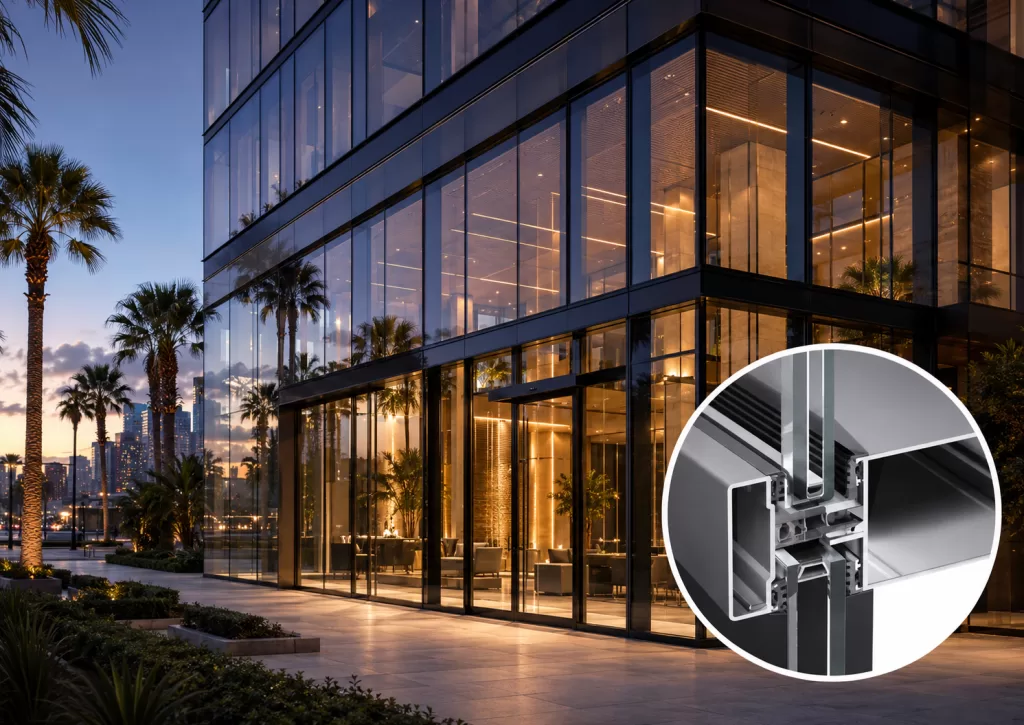
That’s why material selection for glazing gaskets and sealing profiles is an engineering decision, not a purchasing decision. The right compound delivers air/water tightness, comfort, and long-term reliability. The wrong compound can meet a spec on paper, and still lose function in the field
This guide breaks down:
- The core elastomers used in glazing
- The properties that actually drive performance
- How climate and application determine the best choice
- What hardness (durometer) means, and what it doesn’t
Why Glazing Material Selection Matters More Than Most Specs Suggest
A glazing profile can look perfect at install and still fail long-term if the compound:
- takes a permanent compression set
- loses flexibility in cold
- degrades under UV/ozone
- migrates plasticizers (in some PVC blends)
- can’t accommodate movement cycles without deformation
In short: performance is not just “material type”, it’s how that compound behaves under real operating conditions.
The Six Core Elastomers Used in Glazing Systems
Below are the most common material families you’ll encounter in architectural glazing profiles:
1) EPDM (Ethylene Propylene Diene Monomer)
Best known for: exterior durability and weather resistance
Where it shines:
- Excellent UV/ozone resistance
- Strong temperature cycling performance
- Good long-term water resistance
- Commonly used in curtain wall, storefront, and window wall systems
Watch-outs:
Performance varies by formulation, especially around compression set and heat aging.
2) Silicone (VMQ)
Best known for: extreme temperature range and stability
Where it shines:
- Broad thermal operating range
- Excellent UV stability
- Often preferred for high-heat or high-exposure areas
- Common in structural glazing environments (when compatibility is required)
Watch-outs:
Cost is higher; tear strength can be lower depending on formulation and geometry.
3) Neoprene (CR)
Best known for: oil/flame/abrasion resistance in legacy specs
Where it shines:
- Strong resistance to oils and certain industrial exposures
- Used when flame resistance or specific chemical environments matter
Watch-outs:
Typically less UV-stable than EPDM; not always ideal for long-term exterior exposure.
4) Thermoplastic Elastomers (TPE / TPV)
Best known for: co-extrusion flexibility and process advantages
Where it shines:
- Useful in co-extruded profiles
- Can combine rubber-like sealing with thermoplastic carriers
- Good option when the design needs multi-material performance (e.g., wipe seals + rigid carriers)
Watch-outs:
Formulation matters significantly, especially for heat aging and long-term compression stability.
5) Rigid & Flexible PVC (PVC / uPVC)
Best known for: cost-effective carriers and frame interface profiles
Where it shines:
- Common in storefront and residential window frames
- Often used as rigid carriers with flexible sealing elements
Watch-outs (important):
- Flexible PVC depends on plasticizers; lower-quality formulations can stiffen over time.
- Long-term performance requires validated compound quality and stability.
6) Co-Extruded Profiles (Hybrid Systems)
Best known for: combining properties in one engineered profile
Where it shines:
- Merges rigid carriers (PVC or aluminum interface components) with EPDM/TPE wipe seals
- Improves installation consistency and reduces assembly steps
- Lets you design “stiff where needed” and “compliant where needed”
Watch-outs:
Co-extrusion needs strong process control, bonding integrity and dimensional accuracy are critical.
Key Properties That Drive Real Glazing Performance
Specs can be long. But glazing engineers typically focus on a handful of properties because they correlate directly with field outcomes:
Durometer (Shore A)
What it affects: sealing force, contact pressure, and deflection
- Too hard → insufficient deflection, harder to seal
- Too soft → extrusion risk, weak recovery under load
Takeaway: durometer is a starting point, not the decision.
Compression Set
What it affects: whether the gasket keeps sealing after sustained compression
Low compression set = the gasket retains its ability to rebound and keep contact pressure.
This is often the most predictive property for long-term gasket performance.
Tensile Strength
What it affects: durability during installation and mechanical stresses
Important for driven-in profiles (tongue/wedge) and high-handling environments.
Elongation at Break
What it affects: ability to tolerate movement, corners, and curved paths
Higher elongation can help prevent cracking and failure under deformation.
Heat Aging
What it affects: long-term retention of hardness and mechanical properties
Especially critical for dark gaskets and high solar exposure façades.
Low-Temperature Flexibility
What it affects: performance in cold climates where materials embrittle
A gasket that stiffens too much can lose sealing contact under movement/deflection.
UV / Ozone Resistance
What it affects: cracking, chalking, loss of compliance over time
Essential for any exterior-exposed glazing profile.
What the Right Gasket Actually Delivers (Beyond the Data Sheet)
When the compound is correctly selected and validated, it supports outcomes that matter to owners, contractors, and occupants:
- Air & water barrier integrity (tightness maintained over time)
- Acoustic performance (reducing vibration and noise transfer)
- Thermal performance (reducing leakage paths at interfaces)
- Installation speed & reliability (better fit-up, fewer field issues)
- Warranty alignment (materials and test requirements met)
- Service life extension (fewer replacements, fewer callbacks)
Matching Material to Application and Climate
There is no “best” gasket material, only the best material for a specific system, climate, and load environment.
Here are practical starting points:
Curtain Wall (Exterior)
- EPDM (commonly 65–70 Shore A) for UV/ozone + long-term compression set performance
- Validate compression set and heat aging for the façade exposure profile
Structural Glazing (SSG)
- Often silicone gaskets
- Confirm compatibility requirements with the sealant system and assembly conditions
Commercial Storefront
- EPDM or neoprene for durability; co-extruded wipes where needed
- Ensure dimensional stability and consistent compression at pressure points
Residential Windows
- EPDM or co-extruded TPE/PVC systems depending on design
- Verify long-term stability (including any plasticizer considerations)
Interior Partition Glass
- Lower exposure: EPDM or neoprene may be appropriate
- Focus on fit, appearance, and movement requirements
High Solar-Gain Facades
- silicone or heat-stabilized EPDM
- Heat aging validation becomes a priority
Cold Climate Applications
- EPDM or silicone with confirmed low-temp flexibility
- Validate performance under cold deflection and cycling conditions
Hardness in Glazing: What It Defines (and What It Doesn’t)
Durometer (Shore A) influences:
- compression force
- contact pressure
- sealing “feel”
- deformation under load
But long-term success depends on:
- compression set
- heat aging
- dimensional stability
- UV/ozone resistance
- system geometry and compression design
A gasket can hit the right durometer and still fail if it takes a high permanent set or degrades under real exposure.
Practical Selection Checklist (Use This Before You Quote or Tool)
Before locking material selection, confirm:
- Application geometry (contact surfaces, compression zones, corners)
- Movement profile (building drift, thermal expansion, wind-load cycling)
- Climate exposure (UV, temperature range, humidity, coastal conditions)
- Sealing target (air/water class requirements and pressure zones)
- Long-term validation (compression set + heat aging + UV/ozone where relevant)
- Manufacturing feasibility (tolerances, co-extrusion feasibility, repeatability)
Conclusion: Material Choice is an Engineering Advantage
In glazing systems, sealing performance is built at the interface, where climate, movement, and compression meet. The best outcomes come from matching material behavior to real operating conditions, not from generic assumptions.
If you’re specifying profiles for curtain wall, storefront, or window wall systems, material selection becomes a lever for durability, comfort, and reduced lifecycle cost.
If you want, paste the system type + climate (city) + gasket function (wedge, tongue, wipe, setting block, etc.), and I’ll propose a recommended short list of materials + the top 3 properties to validate for that scenario.