The industries that depend on sealing solutions are moving toward a more technical and application-driven way of thinking. Across glazing, façades, building envelope, water infrastructure, RV manufacturing, OEM applications, and custom profile development, the seal is no longer viewed as a secondary component. It may be small compared to the full system, but its design, material, geometry, compression behavior, installation fit, and long-term performance can influence how that system works over time.
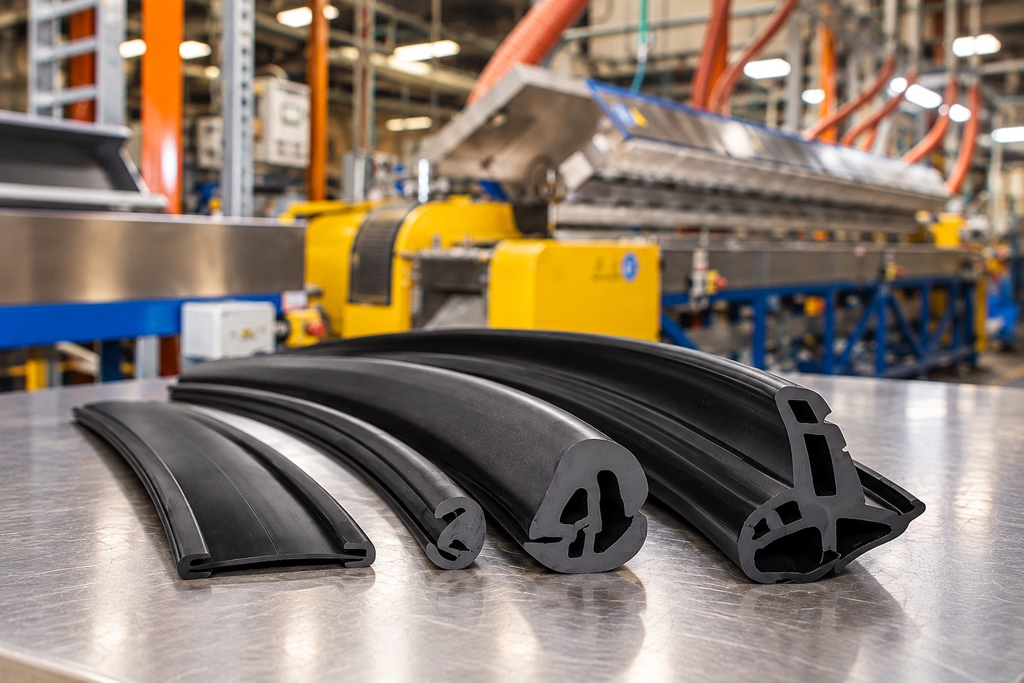
This shift is especially visible in commercial glazing and building envelope applications. As buildings are expected to perform better in terms of energy efficiency, comfort, water management, and durability, every component in the system becomes more important. High-performance glass, aluminum framing, thermal breaks, sealants, anchors, gaskets, and drainage paths all need to work together. A glazing system can only perform as intended when its components are developed around the same technical requirements. For sealing profiles, that means understanding the aluminum cavity, glass thickness, movement, compression, exposure conditions, installation process, and expected performance over the life of the system.
This is also why the conversation around codes, standards, and technical validation continues to gain relevance. Manufacturers and project teams are being asked to make more informed decisions, supported by clearer technical criteria. A gasket is not simply a part that fills a gap. It is a functional component that helps the system respond to air, water, pressure, movement, and exposure. Material compatibility, dimensional tolerances, compression behavior, weather resistance, and installation fit should be reviewed early in the development process, not treated as details at the end.
In water infrastructure, the same principle applies. Aging networks, system rehabilitation, pressure requirements, leak control, and long-term reliability are pushing utilities, manufacturers, and infrastructure teams to look more carefully at the components that support system integrity. In pipe systems, couplings, joints, GRP/PRFV applications, and PVC pressure pipe, the seal plays a critical role at the connection point. Its performance depends on how the material behaves, how the profile fits, how the coupling is assembled, and how the system operates under real conditions.
Climate resilience is also changing how sealing solutions are specified. Buildings, infrastructure, and vehicles are exposed to stronger performance demands: rain, wind, heat, humidity, UV radiation, ozone, temperature variation, pressure, vibration, and repeated movement. These conditions make material selection and profile geometry more important. EPDM, silicone, TPE, TPV, PVC, foam profiles, dense profiles, co-extrusion, and tri-extrusion all have different roles depending on the application. The key is not choosing a material by habit, but selecting it based on what the system needs to withstand, support, and maintain over time.
RV and OEM applications reflect this trend in a very practical way. Recreational vehicles are built for movement, weather exposure, vibration, frequent use, and changing environmental conditions. Entry doors, windows, slide-outs, compartments, and exterior assemblies all require seals that can support fit, comfort, protection, noise control, water management, and durability. In these applications, a sealing profile is part of the user experience as much as it is part of the assembly. When a seal is developed around the real movement and exposure of the vehicle, it contributes to a more consistent and reliable system.
Another important trend is the growing need for custom profiles. As systems become more specific, standard profiles cannot solve every application. Customers need sealing solutions developed around their own cavities, tolerances, assembly methods, movement requirements, and performance expectations. This is where engineering support becomes essential. Custom development is not only about producing a different shape. It is about understanding how the profile will behave inside the full system, from material selection and tooling to validation and repeatable production.
The role of the supplier is also evolving. In B2B industries, customers are looking for technical partners who can support the process beyond the product itself. Engineering review, manufacturing capability, logistics coordination, responsive service, and after-sales support are becoming part of the value proposition. For glazing, infrastructure, RV, and OEM projects, delays, specification changes, or fit issues can affect the full project timeline. That makes communication, technical guidance, and follow-through as important as production capacity.
For TrustSeal, these trends reinforce a clear direction: sealing solutions must be developed around real applications, not generic assumptions. Every system has its own requirements. Every environment creates different demands. Every profile should be designed around how it needs to fit, compress, move, seal, and perform over time.
In glazing, the seal helps support air and water control, thermal comfort, acoustic performance, movement absorption, and installation consistency. In water infrastructure, it contributes to watertightness, assembly fit, pressure behavior, and long-term reliability. In RV and OEM applications, it supports comfort, protection, fit, movement, and durability under real-use conditions.
The market is moving toward systems that are more efficient, resilient, durable, and reliable. In that context, the seal has a larger role than many people realize.
At TrustSeal, we develop engineered sealing solutions, not generic products.
Performance starts at the seal.