Engineers and utility managers invest significant resources specifying pipe material, diameter, and pressure ratings. Yet one of the most critical components in any pipeline system is often underestimated during design and procurement: the pipe joint seal.
A single gasket failure in a pressurized water main can trigger major leakage, ground subsidence, service interruption, and even contamination events, impacts measured not only in repair costs, but in public trust and public health risk.
At TrustSeal Corp, we engineer and manufacture high-performance rubber sealing systems for water and sewer infrastructure. Our gaskets aren’t accessories, they are a primary defense layer for long-term pipeline integrity.
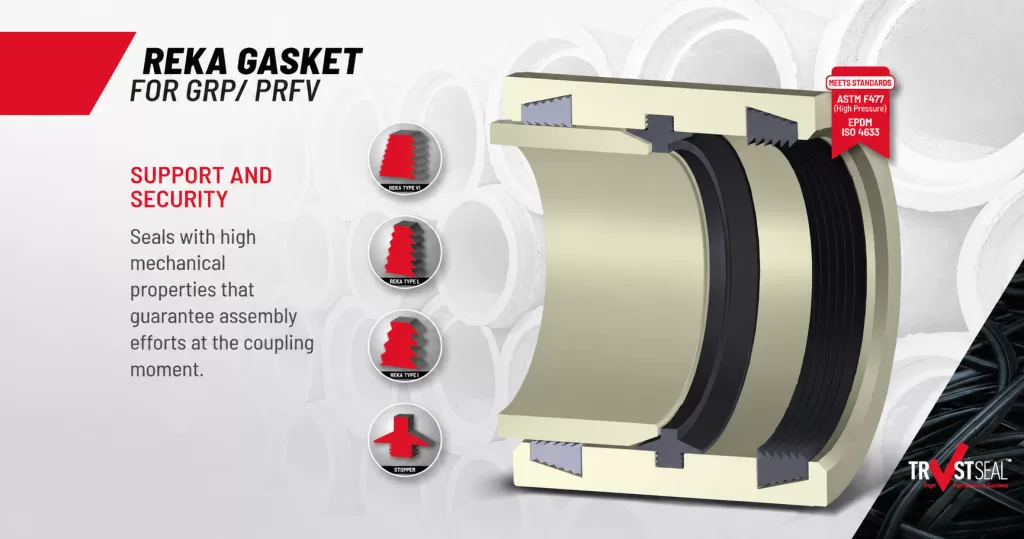
Why Joint Performance Is a System-Level Risk
In water networks, it’s common to focus attention on pipe body strength and material selection. However, the pipeline is only as reliable as its joints.
A joint seal must consistently maintain performance under:
- Internal pressure fluctuations
- Soil settlement and movement
- Thermal cycling
- Installation tolerances and field variability
- Long-term mechanical stress
When any of these variables exceed what the seal was engineered to handle, leaks can occur, even if the pipe itself meets specification.
The Hidden Cost of Leakage in Aging Infrastructure
Water loss and emergency repairs are not isolated issues, they accumulate into operational and financial burden for municipalities.
Every leak can mean:
- Higher non-revenue water (NRW)
- Emergency excavation and restoration
- Traffic disruption and community impact
- Accelerated asset deterioration
- Increased liability exposure
That’s why joint sealing should be treated as a performance-critical engineering decision, not a commodity line item.
What High-Performance Gaskets Must Deliver
A gasket that supports long-term reliability must be designed to deliver:
1) Long-Term Compression Stability
The seal needs to maintain a stable sealing force over time, without excessive relaxation or loss of geometry.
2) Leak Prevention Under Pressure
A seal must hold against real pressure conditions and micro-movements without allowing water pathways to form.
3) Movement Accommodation
Pipelines move. The seal must accommodate angular deflection, vibration, and settlement while protecting the joint.
4) Durability in Demanding Environments
From aggressive soils to fluctuating temperatures, durability is defined by compound behavior and design, not only thickness.
TrustSeal’s Engineering Approach
At TrustSeal, our focus is engineering-first sealing performance.
We support infrastructure applications by aligning:
- Compound selection (EPDM and specialized rubber formulations)
- Profile geometry (joint compatibility and movement handling)
- Manufacturing consistency (repeatable fit and compression behavior)
- Application requirements (pressure, installation, and operating conditions)
Our goal is simple: help utilities and contractors reduce uncertainty and increase joint reliability—project after project.
When to Re-Evaluate Your Joint Seal Specification
If your system is experiencing any of the following, gasket engineering should be revisited:
- Recurring joint leaks in specific segments
- High variability in installation outcomes
- High-pressure conditions or surge events
- Settlement-prone zones
- Aging systems entering rehabilitation cycles
Conclusion: Reliability Starts Where the Pipe Connects
Pipelines are engineered systems, and the joint is where performance is proven.
If your network reliability depends on long-term sealing integrity, the gasket must be treated as an engineered component with clear performance requirements.
Pipeline integrity starts, and ends, at the joint.
Ready to align a sealing solution to your project?
Connect with our team for a technical review:
https://trustsealcorp.com/contact-us/