
In architectural glazing, sealing performance depends on more than profile shape. Long-term results are shaped by how the profile behaves under real conditions: compression, movement, installation tolerances, and durability demands.
That’s where double coextrusion hardness becomes a practical engineering advantage. It is an advanced coextrusion process that combines two material zones in a single composite profile, so each zone delivers a specific function based on the application
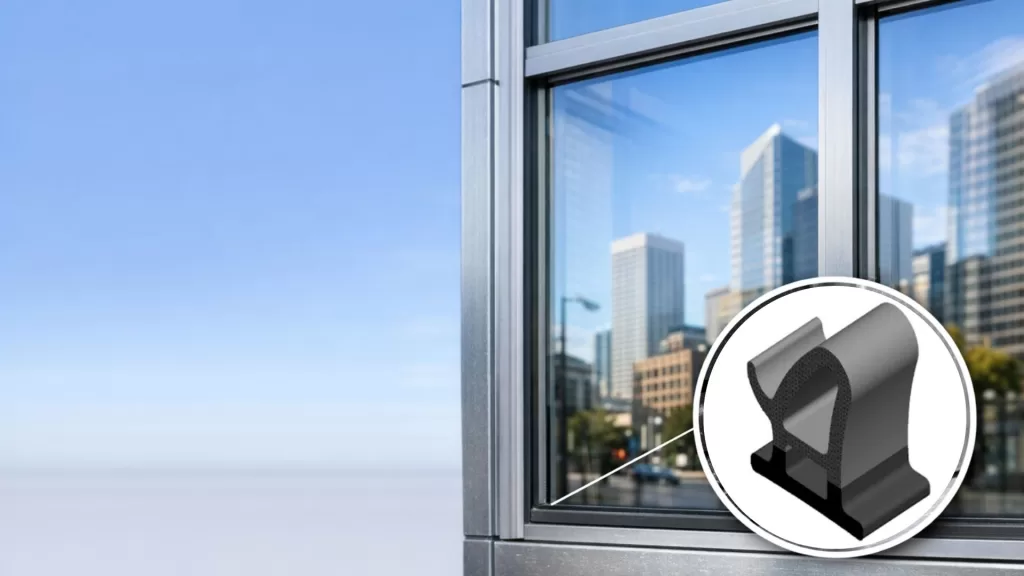
What is double coextrusion hardness?
Double coextrusion hardness is a manufacturing process used to build composite profiles from two material zones, often a harder support/anchoring zone and a softer compression/sealing zone. This allows one profile to balance structural guidance and sealing performance without adding extra assembly steps.
Why it matters in glazing systems
Glazing systems need seals that:
- stay anchored and stable through time
- compress consistently to support air/water control
- contribute to thermal and acoustic comfort outcomes
- maintain performance across cycles and demanding environments
Double hardness coextrusion supports this by engineering the sealing behavior into the profile itself, one zone for support, one zone for compression and sealing.
Typical architectural applications
TrustSeal highlights architectural use cases where double hardness coextrusion improves installation and performance, including thermal and acoustic insulation systems for window and door manufacturing. In these systems, a harder anchoring zone provides support while a softer zone compresses to ensure sealing and insulation.
Material combinations: EPDM and VMQ (Silicone)
Depending on the system requirements, TrustSeal works with multiple material pairings, including:
- Sponge EPDM + Solid EPDM (dense)
- Solid EPDM + Solid EPDM (different hardnesses)
- Spongy VMQ + Solid VMQ (dense silicone)
- Solid VMQ + Solid VMQ (different densities/hardnesses)
These combinations help align the profile’s behavior with compression needs, anchoring requirements, and environmental exposure.
Engineering benefits: what two zones unlock
When engineered correctly, double coextrusion hardness helps deliver:
1) Secure anchoring + stable guidance
A more rigid zone supports retention and stability in the system interface, improving fit and guidance, especially in assemblies with repeated motion or tolerance sensitivity.
2) Reliable compression + better sealing
A softer zone compresses more effectively, supporting sealing performance against dust, water, and noise, while maintaining consistent contact in real conditions.
3) Reduced assembly complexity
Two functions integrated into one profile can reduce the need for additional components or assembly steps, supporting manufacturing efficiency.
Example use case: one profile, two functions
TrustSeal describes a double hardness coextruded profile where the solid EPDM body provides structure and guidance, while a foam EPDM flange acts as a barrier against dust, water, and noise, illustrating how each zone contributes to a specific performance role
Applied engineering for glazing performance
In glazing systems, performance improves when geometry, material behavior, and manufacturing feasibility are aligned from the start. Double coextrusion hardness gives engineers a way to integrate those performance needs into the profile design itself.
Let’s align your application
If you’re developing window, door, storefront, curtain wall, or thermal/acoustic interface components, TrustSeal can support technical alignment for coextruded profile design and material selection.
Connect with our team: https://trustsealcorp.com/contact-us/