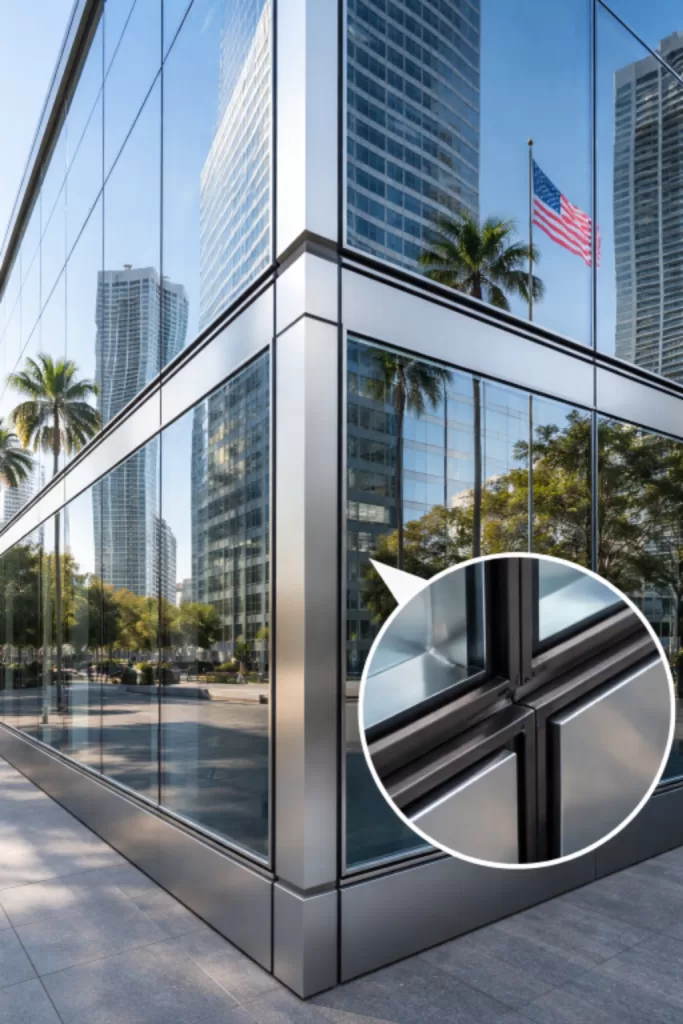
Modern building envelopes are expected to deliver far more than visual impact. Today’s façade systems are engineered to manage wind loads, support air and water tightness, accommodate structural movement, and maintain durability through continuous environmental exposure.
Behind that performance is a set of components that often receive less attention than glass and aluminum, yet play a central role in how façades behave in real conditions. One of those components is the glazing gasket.
Glazing gaskets and sealing profiles help determine how consistently a façade performs over time: from installation alignment to long-term resistance against climate cycles, vibration, and pressure differentials.
Why facade performance is more than architecture
A façade may look complete when the glass is installed, yet performance is defined by what happens afterward, through seasons, storms, and daily temperature swings.
High-performance facade systems are designed to support:
- Air and water tightness to protect interior environments
- Thermal comfort by controlling infiltration and supporting insulation strategy
- Acoustic comfort by maintaining continuous sealing lines
- Structural resilience by absorbing movement and vibration
- Long-term durability under UV, humidity, salt air, and weathering
Every one of these areas depends on technical decisions at the interface, where components meet and sealing continuity is built.
The glazing gasket: a key engineering component in modern facades
In curtain wall, storefront, and window wall systems, glazing gaskets and profiles support performance at the most critical points: glass edges, frame interfaces, pressure zones, and movement joints.
A gasket’s job goes beyond “filling a gap.” It is engineered to deliver predictable behavior under real conditions:
- Controlled compression to maintain contact without overloading the system
- Elastic recovery to keep performance consistent through cycling and aging
- Dimensional stability to support repeatability across units
- Material resistance to handle UV exposure and environmental stress
When these characteristics are aligned to the application, façade performance becomes more reliable and repeatable.
What modern facade systems demand from sealing solutions
1) Air and water tightness under pressure differentials
Air and water control depends on continuity. Seals help maintain a stable barrier under changing pressure conditions caused by wind, stack effect, and environmental exposure.
2) Movement absorption and vibration control
Buildings move, through thermal expansion, live loads, and wind-induced vibration. Seals and gaskets support dynamic performance by maintaining contact and continuity under motion.
3) Dimensional consistency for repeatable performance
Small dimensional deviations can alter compression behavior and affect long-term tightness. Precision in profile geometry supports consistency across manufacturing and installation.
4) Environmental resistance in demanding climates
Coastal environments, extreme heat/cold, humidity, and UV exposure influence material behavior over time. Material selection must match the environment and the system’s performance targets.
Engineering-first selection: how the right seal supports the right system
Sealing solutions perform best when selection begins with real application requirements:
- System type: curtain wall, storefront, window wall
- Exposure: exterior UV, humidity, salt air, pollution
- Movement: expansion joints, vibration, drift
- Load behavior: compression zones, retention, pressure distribution
- Lifecycle targets: durability, maintenance planning, performance stability
This approach leads to better alignment between material behavior, profile geometry, and the conditions the façade will experience in the field.
The result: facades built for long-term performance
When sealing is treated as part of facade engineering, projects gain:
- stronger air and water control
- more stable thermal and acoustic comfort outcomes
- improved durability and long-term envelope integrity
- predictable performance across production and installation
In other words: performance becomes designed, not assumed.
TrustSeal approach: engineered sealing performance for glazing systems
At TrustSeal, we develop engineered sealing solutions for demanding façade applications. Our work integrates:
- application-driven material selection
- profile engineering for compression and fit
- process capability for consistent output
- technical support to align sealing decisions with system requirements
Because in modern facades, long-term performance is built at the interface, where details carry engineering responsibility.
Schedule a technical discussion
If you’re developing or optimizing curtain wall, storefront, or window wall systems, our team can support technical alignment for your sealing requirements.
Connect with our engineering team:
https://trustsealcorp.com/contact-us/